
How a Market Challenger Became #1: E-commerce Store Boosts Organic Traffic by 96.6% in 8 Months

Industry: eCommerce
Use case: SEO Link Building
Company size: Mid-size
Region: Croatia

Through a link-building strategy, this e-commerce business, established in 2001, transformed from a strong contender into a market leader. By contributing guest posts to respected industry sites and adding contextual links to high-traffic articles, the store improved its visibility and surpassed the competitor that once held the advantage in its market.
Gaining visibility in search results to compete with the top competitor
Though the store had a solid reputation, a key competitor had twice its organic traffic. To become the #1 choice for online shoppers, the store needed greater visibility in search results and a way to close the gap with the top player.
Driving traffic with smart content and links
We confronted the strongest competitor directly, targeting the same high-value keywords and building a higher volume of quality links. This approach included:
Guest posts on relevant sites
Writing articles for relevant sites, naturally placing product and category pages.
Contextual link placements
Adding the store’s links into relevant, well-performing articles already attracting the right audience.
Competitive keyword targeting
Ranking higher for top-tier search terms that brought the most organic traffic.
Measurable growth through link building
By focusing on quality placements and targeting the right keywords, the store achieved:
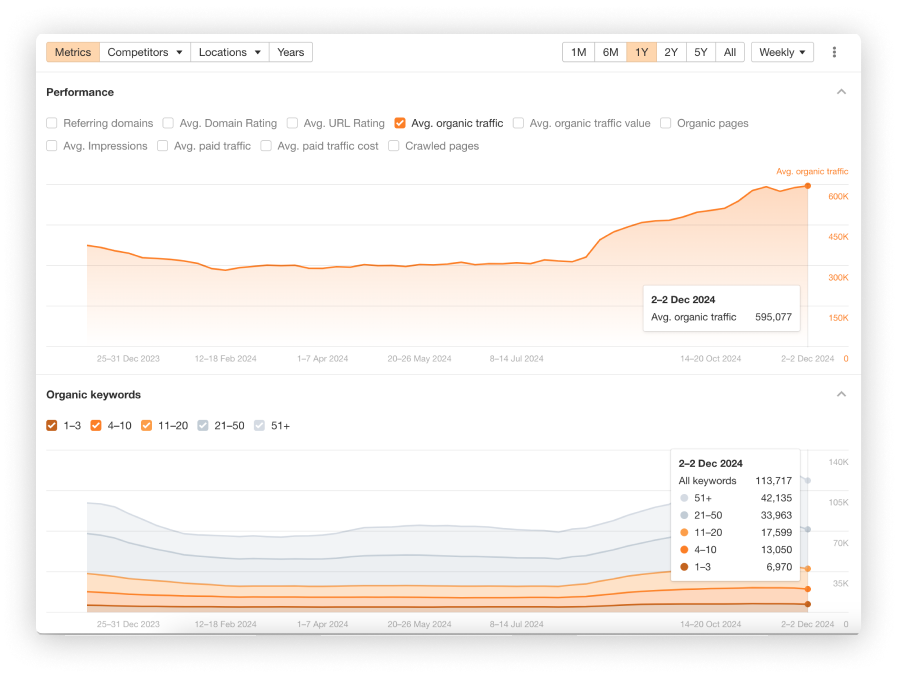
increase in total keywords
to 113,717, up from 67,238.
Domain rating increased from DR 42 to DR 50, indicating stronger authority in the eyes of search engines.
Traffic value grew from $22K to $43.9K, turning improved rankings into meaningful returns.
Organic traffic increased from 302,725 to 595,077 visitors, a 96.6% increase.
Ecommerce SEO case study: what happened in eight months
The store had been trading online since 2001 and ranked for 67,238 keywords when the engagement began, so this was never a site that lacked content or history. Its problem was a single competitor with roughly twice its organic traffic, holding the top positions for the category terms that drive most ecommerce revenue. Closing that gap in eight months meant changing the one input the store had not been investing in: the authority of the pages that needed to rank.
The plan had three parts. Guest posts on respected publications in the store’s market, written to place product and category pages where they belonged in the text. Contextual link placements inside articles that already ranked and already attracted the right readers. And competitive keyword targeting, so that every placement pointed at a page competing for a top-tier term rather than at the homepage. The outcome was a 96.6% increase in organic traffic, from 302,725 to 595,077 visitors, and the number one position in the market.
Why links were the lever for this store
An ecommerce site with two decades of history and tens of thousands of ranking keywords usually has the content side covered. What it rarely has is enough authority flowing to the category pages, because category pages attract almost no links by themselves, because nobody cites a product listing. When a competitor holds a Domain Rating advantage and the same category terms, the gap shows up precisely on those pages, and no amount of on-page work closes it.
That diagnosis decided the method. Rather than publishing more content and hoping it attracted links, the campaign placed links directly to the pages that needed them, on publications whose readers overlapped with the store’s buyers. Relevant links to category pages move category rankings; that is the entire mechanism, and it is why the keyword count grew by 69% while the site’s content barely changed.
How the placements were chosen
Every candidate publication had to pass the same checks we apply to any client: real organic traffic, a readership in the store’s market, editorial control over what gets published, and a page that made sense as a home for the link. Guest posts went to industry sites where a buying guide or a how-to piece could naturally reference the store’s categories. Contextual placements went into existing articles that were already ranking and sending visitors, so that the link inherited the trust of a page Google had already judged, instead of waiting for a new article to earn it.
Anchor text followed the page rather than the keyword list. Category pages received descriptive, varied anchors that read as editorial references, which is what keeps a profile looking natural as it grows. The competitive keyword targeting layer decided priority: pages competing for the highest-value terms where the competitor held the lead were linked first, and the rest followed as rankings on the first group moved.
How to read the results
Four numbers describe the eight months, and each measures something different. Total ranking keywords rose from 67,238 to 113,717, which reflects category and product pages entering the results for long-tail variations once their authority improved. Domain Rating rose from 42 to 50; it is a third-party estimate rather than anything Google uses, but a move of that size on an established domain confirms that the referring domains added were real and relevant.
Traffic value grew from 22,000 to 43,900 dollars. This is the estimated monthly cost of buying the same organic clicks through paid search, so it doubles as a yardstick for what the campaign saved compared with ads. Organic traffic itself rose 96.6%, from 302,725 to 595,077 visitors, and because the growth came from category terms it arrived as buyers rather than as readers. Taken together, the store went from challenger to the number one choice in its market, ahead of the competitor that had started with twice the traffic.
What an ecommerce store can take from this
The lessons travel. Point links at category pages, because that is where ecommerce revenue is decided and where links are scarcest. Choose publications by audience overlap and traffic rather than by a metric alone. Prefer placements inside pages that already rank when speed matters, and guest posts when a category needs a fuller editorial reference. Decide priority by the value of the term and the size of the competitor’s lead, and track results per page rather than per site.
Eight months is a realistic horizon for an established store with a clear competitor to overtake; a younger site with fewer ranking keywords will need longer, because the links have less existing equity to multiply. The method is the same one behind our ecommerce link building playbook, and it is what our link building service runs for stores that want the same outcome.