
 By Matija Konjić • Last Updated: January 2026
Key takeaways:
- Digital PR earns editorial links by making content newsworthy – data studies, original research, surveys, or expert commentary that journalists want to cite.
- 48.6% of SEO professionals rank digital PR as their most effective link building tactic, higher than any other strategy.
- Typical digital PR campaign costs $5K-$10K with budgets of $1,250-$1,500 per unique linking domain and earns 6-7 quality links per campaign.
- Expert commentary platforms like Qwoted and Featured offer free, immediate entry into digital PR without the cost of data studies.
- Successful digital PR campaigns earn links from high-authority sites (DA 80+) like Yahoo Finance, Business Insider, and AP News, which carry both ranking power and real referral traffic.
- Google’s algorithm leak confirmed the platform values frequently clicked, regularly updated news articles – exactly what digital PR places your brand into.
Digital PR is the tactic that separates professional link builders from amateurs. It’s the only strategy that consistently delivers links from tier-one publications like Bloomberg, CNN, and the New York Times – and it does so because those sites want to cover your story.
But digital PR is not traditional press releases. You create data, research, or expert commentary that journalists actually want to use in their stories – and links come along with the coverage.
This guide breaks down exactly how to run digital PR campaigns that earn links, what types work best for different industries and budgets, how to pitch journalists, and why it matters more now than ever.
Table of contents
What is digital PR?
Digital PR is the practice of building brand authority and earning links by creating newsworthy content that journalists, bloggers, and other publishers want to cover. The core difference between digital PR and traditional PR is the channel: digital PR operates exclusively through online media, and it’s measurement-focused on the links and traffic it generates.
It’s different from paying a PR firm to blast press releases to a distribution list. Digital PR means creating stories backed by data or expertise, then pitching them directly to the right journalists.
When done right, digital PR generates three concurrent benefits:
- Editorial links from high-authority publications – the primary SEO benefit
- Brand exposure to qualified audiences through publication readers
- Referral traffic from the articles that cover your story
All three happen simultaneously, and all three matter for business. This is also why digital PR sits firmly on the white hat side of link building – journalists link to you because the story is worth covering.
Why digital PR is so effective for SEO
The data backs this up. In the most recent Editorial.Link survey of 518 SEO professionals, 48.6% named digital PR as their most effective link building tactic – higher than guest posting, niche edits, broken link building, or any other strategy tracked in the study.
That’s not because digital PR is the easiest or cheapest. It’s because the links it generates are hard to replicate and carry serious weight. Here’s why:
The quality of publication authority
Digital PR campaigns regularly place content on high-authority sites. We’re talking about Yahoo Finance, Business Insider, AP News, Forbes, TechCrunch, and equivalent Tier-1 publications in every industry. These sites have domain authority scores of 80-94, strong organic traffic, and large readerships. A single link from any of these sites carries more algorithmic weight than dozens of links from mid-tier sites.
Link scarcity and natural ratios
Because digital PR campaigns require real research and real data, the supply of these links is naturally limited. You can’t produce 50 data studies per month. You can produce maybe one every quarter. This scarcity means Google weights each link more heavily – the algorithm assumes that high-authority sites only link to things worth linking to, and these placements are hard to replicate at scale.
Google’s preference for news content
The 2024 Google algorithm leak revealed that the platform specifically values pages with these characteristics: frequently clicked, regularly updated, and treated as news. That describes digital PR placements perfectly – articles that cover your story are news by definition, they accumulate engagement as they spread, and they’re updated as the story develops. The algorithm treats news content more favorably than static web pages, which means digital PR links arrive with built-in algorithmic amplification.
Referral traffic and secondary signals
Unlike other link building tactics that might generate links to pages with minimal reader traffic, digital PR generates coverage that people actually click on, read, and share. These clicks and engagement signals reinforce the quality of the link in Google’s algorithmic evaluation. A link that brings 1,000 real readers is treated differently than a link that brings 10.
5 types of digital PR campaigns
Not all digital PR campaigns are created equal. Different types serve different business goals, have different cost profiles, and work better for different industries. Understanding each type helps you choose the right strategy for your situation.
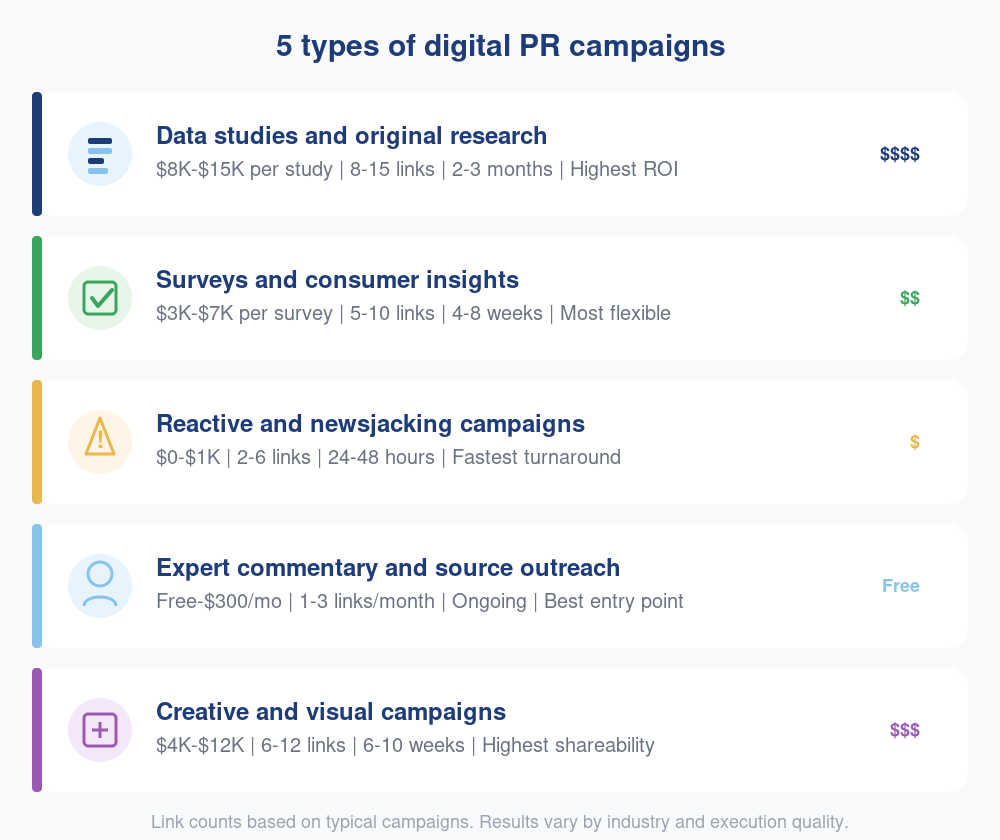
1. Data studies and original research
This is the highest-ROI type of digital PR. You commission original research – analyzing your own data, conducting surveys, running experiments – and package it into a newsworthy finding. Journalists love data-driven stories because data gives them something concrete to write about.
Examples: “We analyzed 10,000 job listings and found that companies using inclusive language hire 23% faster,” or “Survey of 5,000 remote workers reveals 67% suffer from Zoom fatigue.”
Cost: $8K – $15K per study (research design, surveys, analysis, and asset creation)
Expected links: 8-15 from quality publications
Timeline: 2-3 months from planning to final media coverage
Best for: B2B companies, SaaS, HR tech, financial services, and any industry with meaningful data to uncover
2. Surveys and consumer insights
Surveys are lighter-weight than full research studies but still generate legitimate newsworthy findings. You create a survey, gather responses from your audience or a panel provider, analyze the results, and create an infographic or visual report journalists can cite and embed.
Examples: “Survey: 73% of marketers plan to increase video content in 2026,” or “What do small business owners actually want in accounting software? We asked 2,000 and got surprising answers.”
Cost: $3K – $7K per survey
Expected links: 5-10 from quality publications
Timeline: 4-8 weeks
Best for: Any industry. Surveys are the most flexible digital PR format.
3. Reactive/newsjacking campaigns
This is opportunistic digital PR. A news event happens – a regulatory change, industry disruption, cultural moment – and you quickly create expert commentary or analysis that piggybacks on the news cycle. The key to newsjacking is speed: you have 24-48 hours to pitch before the news cycle moves on.
Examples: When a payment processor gets hacked, fintech companies pitch expert commentary on payment security. When employment numbers drop, HR platforms pitch analysis on hiring trends. When a new AI tool launches, SaaS companies pitch commentary on AI adoption.
Cost: $0 – $1K (mostly staff time, minimal budget)
Expected links: 2-6 depending on news relevance
Timeline: 24-48 hours to pitch, links come within days
Best for: Companies that can move fast and have executives willing to go on record
4. Expert commentary and source outreach
Journalists need expert sources all the time. Platforms like Qwoted, Featured, and SourceBottle connect your executives directly with journalists looking for commentary. You create a profile, pitch yourself as an expert in your field, and wait for journalists to request your input on their stories.
Examples: A journalist writing about “How to hire for cultural fit” searches for HR experts and finds you. A piece on “The future of remote work” needs a perspective from someone in the space – that could be you.
Cost: Free to $300/month for platform subscriptions
Expected links: 1-3 per month on average, lower but consistent
Timeline: Ongoing, passive
Best for: Early-stage companies or anyone wanting to start digital PR without high budget commitment
5. Creative and visual campaigns
Sometimes the news hook is the creative asset itself – an interactive calculator, a unique visualization, a novel study methodology, or a viral-worthy concept. These campaigns generate coverage primarily because the asset itself is interesting to share.
Examples: An interactive calculator showing “how much you’re leaving on the table with your current vendor,” a visualization of how supply chains have shifted post-pandemic, or a gamified assessment that journalists embed in their own coverage.
Cost: $4K – $12K depending on creative production
Expected links: 6-12 from a strong creative concept
Timeline: 6-10 weeks
Best for: Companies that can invest in design and development, industries where visual storytelling is natural
How to create a data-driven campaign that earns links
Data-driven campaigns (studies, surveys, original research) are the highest ROI form of digital PR. Here’s the step-by-step process to create one that journalists actually want to cover.
Step 1: Identify a newsworthy angle
Start with a question that journalists would want to answer. Not a question only your company cares about – a question that has broader industry relevance. The angle needs to be surprising or counterintuitive. “We surveyed 1,000 marketers and they all use email marketing” is not newsworthy. “We surveyed 1,000 marketers and 67% ignore AI tools altogether” is.
Good news angles share a few characteristics:
- They reveal a trend or shift (something is changing in a meaningful way)
- They contradict conventional wisdom (the result is surprising)
- They have broad industry relevance (journalists outside your immediate niche would care)
- They answer a question that people are already searching for
Step 2: Determine your data source
You have three options: use your own company data, conduct original research, or partner with other companies. Your own data is free but potentially limited. Original research (surveys, studies) costs money but gives you complete control. Partnerships are cheaper and add credibility but require coordination.
For maximum credibility with journalists, larger sample sizes are better. A survey of 1,000+ respondents carries more weight than a survey of 100. A study analyzing 50,000+ data points is more defensible than 1,000.
Step 3: Create the visual asset
Journalists don’t want raw data. They want graphics. Create an infographic, an interactive visualization, or a simple one-page PDF that distills your key findings into visual form. This serves two purposes: it makes the data easy to understand, and it gives journalists a visual they can embed in their coverage.
Step 4: Write the press release (but don’t lead with it)
Create a written summary of your findings – 300-500 words covering the key insights, methodology, and implications. This becomes your resource document for journalists. Don’t lead with this in outreach – it exists as reference material.
Step 5: Build a journalist contact list
Identify the specific reporters and outlets that cover stories like yours. Media databases (covered in the tools section) make this easier. You need at least 20-30 highly relevant contacts to pitch. Quality over quantity: 5 perfect fits beat 50 mediocre matches.
Step 6: Create personalized pitches (not mass emails)
This is covered in detail in the next section, but here’s the preview: each journalist gets a unique pitch that references their recent work and explains why your story is relevant to their beat and their readers.
How to pitch journalists effectively
The pitch is where 90% of digital PR campaigns fail or succeed. A bad pitch gets deleted. A great pitch gets coverage.
The anatomy of a strong pitch email
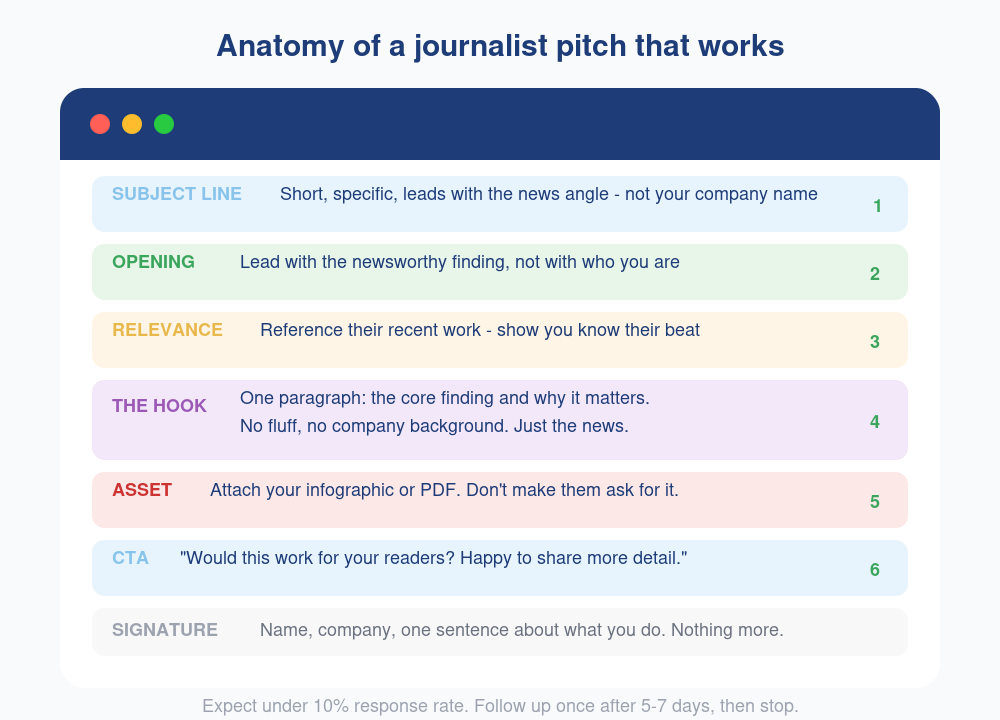
Subject line: Keep it short and specific. Reference the story angle, not your company name. “New data: why remote workers are quitting faster” beats “Check out our new survey!”
Opening line: Lead with the newsworthy finding, not with who you are. “A new analysis of 50,000 job postings shows that companies offering flexible schedules hire 40% faster” works. “We conducted a survey” doesn’t.
Relevance to their beat: Mention a recent article they wrote and explain how your story connects to that beat or audience. “Following your piece on the future of HR tech, this data on employee preferences might interest your readers” – that shows you know their work.
The hook: One paragraph explaining the core finding and why it matters. No fluff, no company background. Just the news.
The asset: Attach your visual (infographic, PDF, one-pager) so journalists can see it immediately. Don’t make them ask for it.
Call to action: Keep it simple. “Would this be interesting for your readers? I can provide more detail or connect you with an expert for additional commentary.”
Signature: Include your name, company, and one sentence about what you do. Nothing longer.
Timing and persistence
Send your pitches on Tuesday through Thursday, between 8am-11am in the journalist’s timezone. They’re usually checking email then and haven’t yet been buried by daily deadlines. Avoid Mondays (email overload) and Fridays (mentally checked out).
Expect a response rate under 10%. That’s normal and not a sign your pitch is bad. Journalists are extremely busy. Follow up once after 5-7 days with a simple “Wanted to make sure this hit your inbox – still think it could work for your readers?” Then stop. More than that feels pushy.
Working with journalists who respond
When a journalist does respond with interest, move fast. They may have a deadline (sometimes 24 hours for online publications). Provide whatever they ask for quickly. If they want expert commentary, get your executive on the call or via email the same day. If they want different angles on the data, extract those immediately. Speed and responsiveness lead to actual coverage.
Tools and platforms for digital PR
You need several categories of tools to run digital PR campaigns effectively: journalist databases, monitoring software, research platforms, and project management.
Media databases and journalist research
- Cision – The largest media database. Expensive ($1K+/month) but most comprehensive contact database.
- Muck Rack – Mid-range option with strong journalist profiles and beat specialization. Good balance of price and quality.
- Qwoted – Flips the model: journalists come to you to request expert commentary. Free to use as a source.
- Featured – Similar to Qwoted, connects executives with journalists. Free platform.
- SourceBottle – Another expert source network. Free to join.
Monitoring and analytics
- Google Alerts – Free and reliable. Set up alerts for your company name and key industry terms to catch coverage in real-time.
- Ahrefs – Backlink monitoring catches links your digital PR campaign generates and tracks their impact on rankings.
- Mention – Monitors mentions and links across the web. Useful for tracking earned media.
- Semrush – Backlink tracking, keyword ranking monitoring, and competitive analysis.
Research and asset creation
- SurveyMonkey, Typeform, or Qualtrics – For survey distribution and analysis.
- Canva – Fast, affordable way to design infographics. Not publication-quality, but good for quick digital PR assets.
- Adobe Creative Suite – For professional-grade design of visualizations and assets.
Project management
- Airtable – Excellent for tracking journalist outreach. Build a database of contacts, pitch status, follow-up timelines, and coverage results.
- Asana or Monday.com – For managing campaign timelines, deadlines, and team coordination.
Measuring digital PR success beyond link counts
Too many companies measure digital PR purely on the number of links earned. That’s incomplete. Here are the metrics that actually matter.
Link-based metrics
- Number of unique linking domains: A campaign that generates links from 8 different DA 70+ sites is better than one that generates 20 links from the same site.
- Domain authority and relevance: A link from a relevant DA 80 site beats 10 links from DA 40 sites. Track the authority of linking sites, not just the count.
- Link sustainability: Check in 3-6 months whether the links are still live. Editorial links usually stick around; low-quality links disappear.
Traffic and engagement metrics
- Referral traffic: Digital PR should drive real readers to your site. Monitor Google Analytics for traffic from the articles that covered you.
- Article engagement: Look at the coverage articles themselves. Are they getting social shares, comments, and time-on-page? That signals the link quality to Google.
Ranking and business impact
- Keyword ranking movement: Did your rankings improve for target keywords after the campaign? This is the ultimate success metric.
- Organic traffic: Measure total organic traffic changes in the weeks and months after campaign launch.
- Lead or conversion impact: Can you trace any leads or customers back to the coverage? This is harder but most valuable.
Brand metrics
- Brand search volume: Monitor whether searches for your brand increase after coverage in major publications.
- Brand mentions: Track how many times your company or product gets mentioned in media coverage.
- Share of voice: How much coverage does your brand get relative to competitors? Digital PR should increase this.
Common mistakes that kill digital PR campaigns
Mistake 1: The angle isn’t newsworthy
You create a survey showing that customers of your product are happy with your product. That’s not news – that’s a testimonial. News is when you uncover something surprising or important about your industry that people outside your company care about. Before you pitch, ask: “Would this story be interesting if a competitor discovered this data?” If the answer is no, the angle needs work.
Mistake 2: Pitching to the wrong journalists
Sending your fintech story to a general business reporter with no finance beat is a waste of everyone’s time. Research journalist beats carefully. Use media databases to find reporters who specifically cover your industry or topic area. Quality targeting beats mass outreach.
Mistake 3: Expecting passive results
You can’t create a data study and expect coverage to happen on its own. Digital PR is proactive. You have to pitch, follow up, and actively place your story. Some of the best campaigns get 0% organic journalist interest and 100% coverage through direct outreach.
Mistake 4: Using jargon in pitches
Journalists need to understand your angle in 30 seconds. If your pitch relies on industry jargon, acronyms, or insider knowledge, they won’t get it. Write your pitch for a journalist who knows your industry at surface level, not an expert insider. Plain language wins.
Mistake 5: Leading with your company
Journalists don’t care about you. They care about the story. “Our company conducted a survey” is a sales pitch. “New data on why people are quitting their jobs” is a story. Lead with the news, not the messenger.
Mistake 6: Being slow to respond
When a journalist shows interest and asks for information or expert commentary, respond within hours, not days. Missed deadlines mean missed coverage. Digital PR moves at the speed of news cycles.
Mistake 7: Not measuring results properly
You count the links but don’t track whether they moved your rankings. You measure links but not referral traffic. You measure campaign success in links but not in business impact. Set up proper measurement before you launch, not after. Having a clear process with defined milestones prevents this from happening.
When digital PR makes sense vs. when it doesn’t
Digital PR is powerful, but it’s not the right tactic for every company or situation. Here’s how to evaluate whether it makes sense for you.
Digital PR is an excellent fit when:
- You have newsworthy data or insights to share (product data, customer data, market research)
- Your industry is covered regularly by mainstream or trade media
- You have an executive who can represent the company on record or via expert commentary
- You have budget allocated: $5K-$10K per campaign minimum
- You can operate on a 2-3 month timeline from campaign start to coverage
- Your business is B2B or B2C in a vertical with active media coverage
- Your competitors are already generating media coverage – you need to match or exceed it
Digital PR is not the right fit when:
- You don’t have interesting data or a newsworthy story
- Your industry has minimal media coverage or trade publications
- Your business is highly niche or operates in an industry with no journalism
- You need links in the next month – digital PR requires time
- You have a very limited link building budget (under $2K/month)
- Your product/service isn’t something journalists or the public would understand or care about
In those cases, alternative tactics like strategic guest posting, broken link building, or niche edits may be better fits. Our link building service uses a mix of tactics depending on what fits your industry, and our complete guide breaks down when each tactic makes sense.
Frequently asked questions
How much does a digital PR campaign cost?
Costs vary significantly by campaign type. Expert commentary platforms are free. A small survey campaign runs $3K-$7K. A full original research study costs $8K-$15K. When broken down by link, you’re paying $1,250-$1,500 per unique linking domain in a successful campaign. These costs cover research, asset creation, and journalist outreach – so each link comes backed by a real story and a real publication.
What’s the difference between digital PR and traditional PR?
Traditional PR focuses on brand reputation and media relationships broadly. Digital PR is narrowly focused on earning editorial links and online coverage. Traditional PR might measure success in “we got media coverage.” Digital PR measures success in “we got links from DA 70+ sites that moved our rankings.” Digital PR is also more data-driven and often relies on owned research or expert positioning rather than press releases.
How long does it take to see results from digital PR?
Data studies take 2-3 months from planning to final coverage. Surveys are faster at 4-8 weeks. Expert commentary can generate links within days. Once coverage is published, ranking improvements typically appear within 4-8 weeks as Google crawls and evaluates the new links. So expect 3-4 months from campaign start to ranking impact in most cases.
Can you guarantee digital PR coverage?
No – and any agency that promises guaranteed coverage is lying. Digital PR depends on journalists deciding your story is worth covering. The best you can do is maximize probability: create genuinely newsworthy angles, pitch to highly relevant journalists, and execute excellent outreach. A well-run campaign might achieve 30-40% pitch-to-coverage conversion if the angle is strong and the journalist list is well researched. Weaker angles might hit 10-15%.
Does digital PR work in every industry?
Digital PR works best in industries that have active journalism and media coverage – finance, technology, healthcare, HR, marketing, consumer goods. It works less well in highly niche industries or in sectors where there are no journalists (an industry with no blogs, no trade publications, no media outlets). In those cases, alternative tactics like expert commentary platforms or guest posting on relevant blogs may work better. Understanding what metrics matter for your specific industry helps you choose the right tactic.
Ready to launch a digital PR campaign?
We build newsworthy campaigns that earn links from top-tier publications and drive real ranking impact.
